Case File Cover
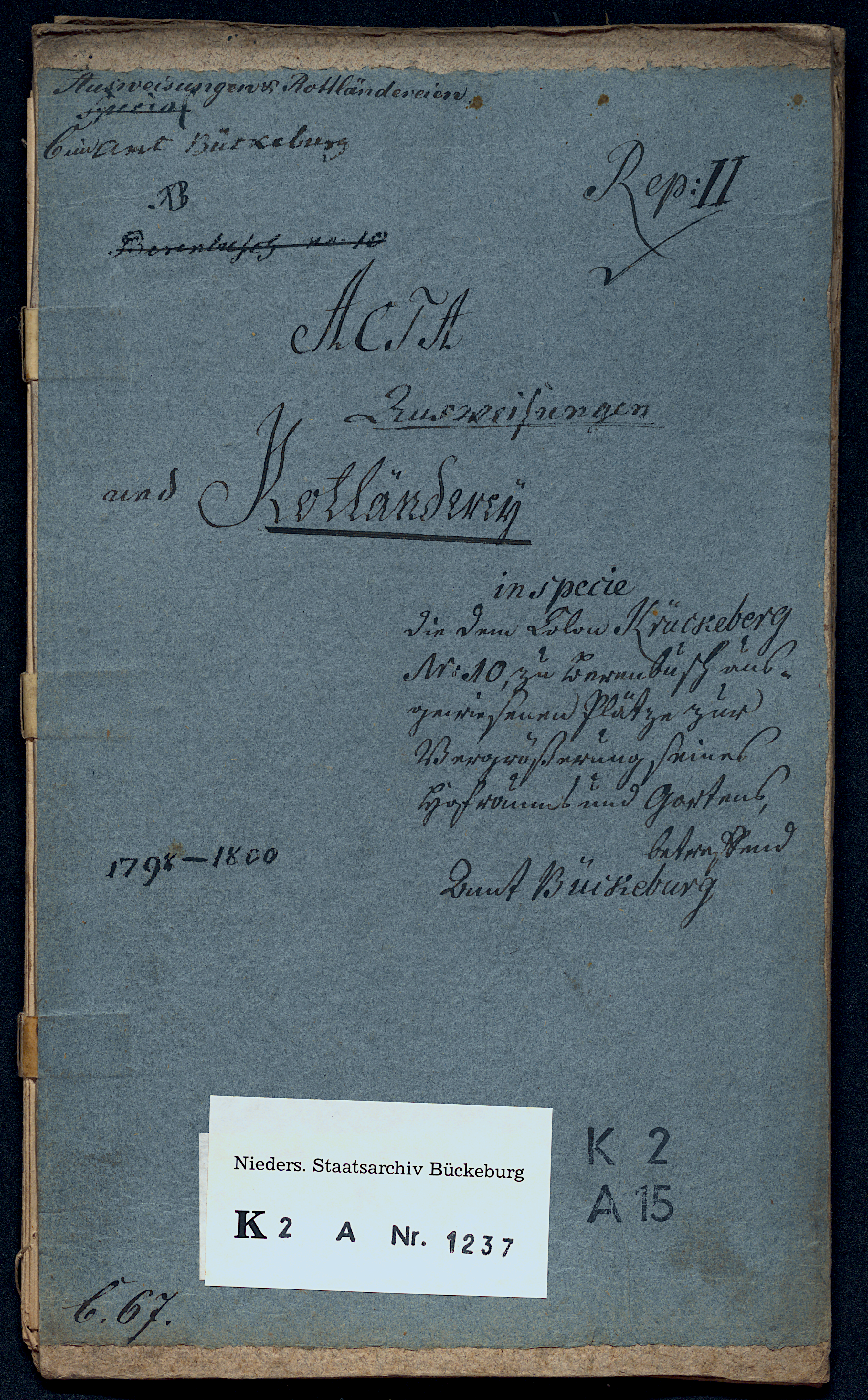
Translation and Translation
Ausweisungen & Rottländereien
Specia
bim Amt Bückeburg

Berenbusch no. 10

AB                         Rep: II

                 ACTA
               Ausweisung
          und Rotländereÿ
                           in specie
                    die dem Colon Krückeberg
                    Nr: 10, zu Berenbusch aus-
                    gewiesenen Plätze zur
                    Vergrößerung seines
                    Hofraums und Gartens,
                    betreffend
1798-1800
                    Amt Buckeburg


C. 67
Land Allocations & Cleared Lands
Case file
at the Office of Bückeburg

Berenbusch No. 10  [struck through]

AB                               Rep: II

                     RECORDS
                   Allocations
               and Fallow Lands

                     specifically concerning
            Regarding the plots assigned to
            Colon Krückeberg, No. 10, in Berenbusch,
            for the enlargement of his
            yard space and garden.

1798–1800
Office of Bückeburg

C. 67 [likely an archival or administrative reference number]
|
Hofraum can be translated "farmyard", but this does not imply this was a farm. Hofraum refers to he yard space of a rural household holding—the open area around the house and outbuildings used for daily work and storage. |
Glossary of Terms
- Ausweisungen
-
Land allocations or assignments. Formal designation of land parcels, often by government or ducal authority.
- Rottländereien
-
Cleared lands (from roden, “to clear”). Forested or unused land prepared for cultivation or settlement.
- specia
-
Likely an abbreviated or corrupted form of in specie. Suggests the file pertains to a specific case, not general policy.
- in specie
-
Latin: “in kind” or “in specific form.” Used to indicate that a matter is addressed concretely, not generically.
- bim
-
Archaic/regional variant of beim (short for bei dem), meaning “at the” — e.g., bim Amt Bückeburg = “at the Office of Bückeburg.”
- Colon
-
A historical title for a hereditary tenant holding, often a farmer (modern German: Kolon).
- Hofraum
-
Courtyard or yard area of a farmstead. Often part of the recorded property area in land documents.
- Garten
-
Garden area, usually for private or agricultural use.
- ACTA
-
Latin for “records,” “files,” or “off
- C. 67
-
A likely archival or administrative reference number. The letter "C" may designate a filing category, shelf, or collection series, while "67" indicates the item or folder number within that series. Such notations were commonly written on dossier covers by clerks or archivists to organize case files for internal tracking or retrieval.