Records of the questioning of the individual rural property holders in Evesen, Berenbusch, Nordholz, and Rusbend in the context of the General Land Survey (land measurement). (1743-1744)
Overview
This is document NLA BU L 2 L Nr. 27/41 in the Arcinsys Archival information system Niedersachsen and Bremen.
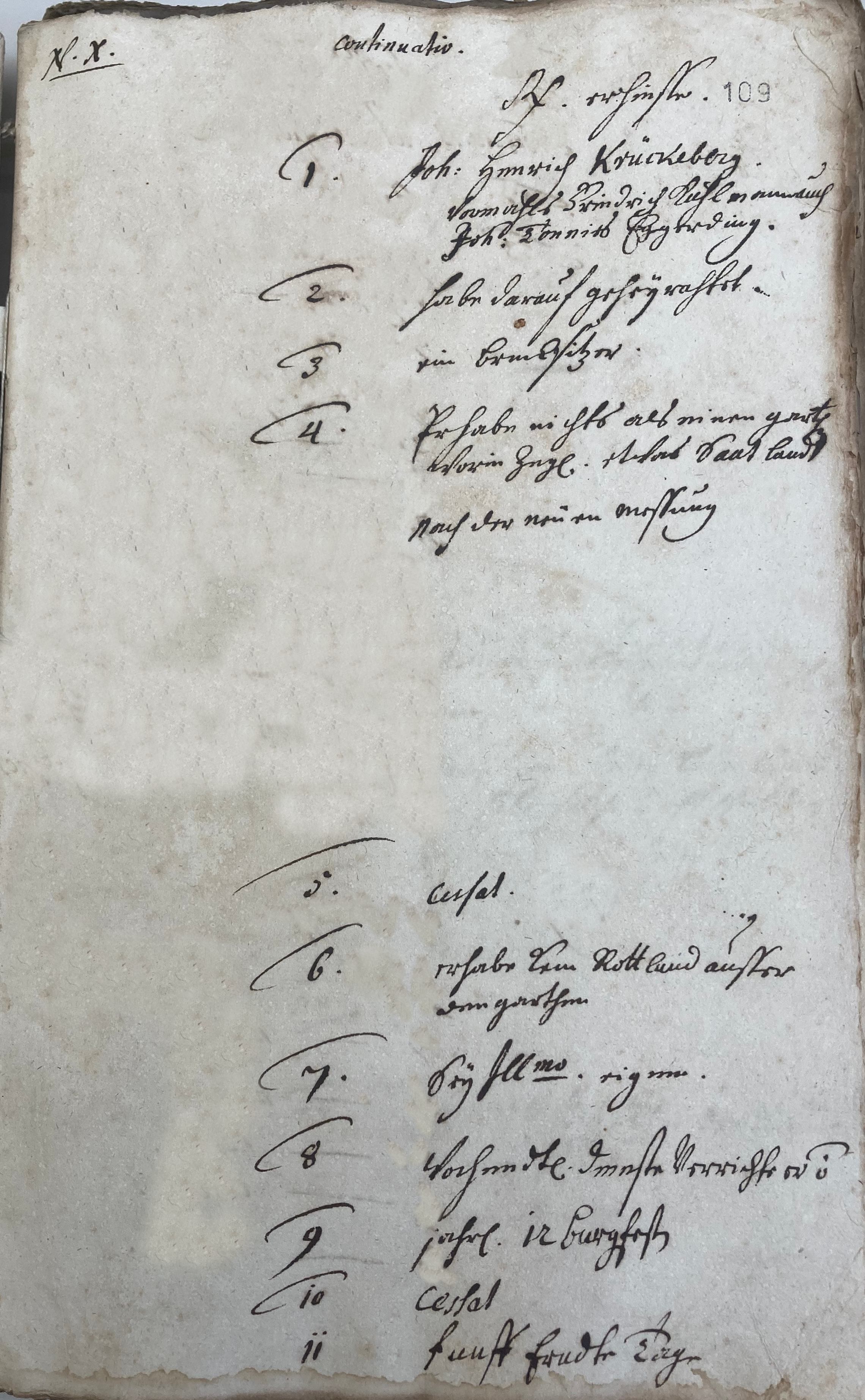
Johann Heinrich Krückeberg is one of the respondents, and therefore a property holder by 1743-44.
Replies of Rural Property Holders
The householders are each asked 40 questions. The questions are not given. Many of the questions were negated by recording either "nescit" (he does not know) or "cessat" (does not apply, falls away), but we do not know what the topics this refers to. Also, some questions are answered by "ut reliqui", which means he had the same conditions as all the others.
| Latin term | Literal meaning | Archival meaning |
|---|---|---|
nescit |
he does not know |
Respondent has no knowledge |
cessat |
it ceases / is absent |
Not applicable / does not exist |
ut reliqui |
like the others |
Same as other respondents |
Images of Johann Heinrich Krückeberg’s Recorded Answers
Transliteration and Translation
Transcript of the report for Johann Heinrich Krückeberg at Berenbusch no. X
|
Johann Heinrich Krückeberg appears to say he married into the property. He says: "habe darauf geheyrahtet". This could mean:
This might suggest he obtained Brinksitzer status of no. 10 Berenbusch through marriage, but we don’t know what the antecedent to the da-compound darauf is because we don’t know what was asked. The 1743–44 general state visitation (Generallandesvisitation) records a succession of holders for Haus Nr. 10 in Berenbusch: Johann Tönnies Eggerding, followed by Friedrich Kuhlmann, and then Johann Heinrich Krückeberg, who acquired the holding through marriage. None of these individuals appears in the 1737 Registration of House and Property Holders in the District of Bückeburg as Part of a General Land Survey (1737), likely because they did not meet the criteria of property holders. |
N. X [Rf?] er hiesse

1. Johann Henrich Krückeberg

vormahls Friedrich Kuhlmann auch

Joh. Tönnies Eggerding

2. habe darauf geheyrahtet

3. ein Brinksitzer

4. Er habe nichts als einen Garten

worin zugl. etwas Saatlandt

Nach der neuen Messung.

5. cessat

6. er habe kein Rottland ausser

dem Garthen

7. Sey Illmo eigen.

8. Wöchentl. Dienste verrichte er [symbol = nicht; old code for "not"]

9. jährl. 12 Burgfesten

10. cessat

11. funff Erndte Tage

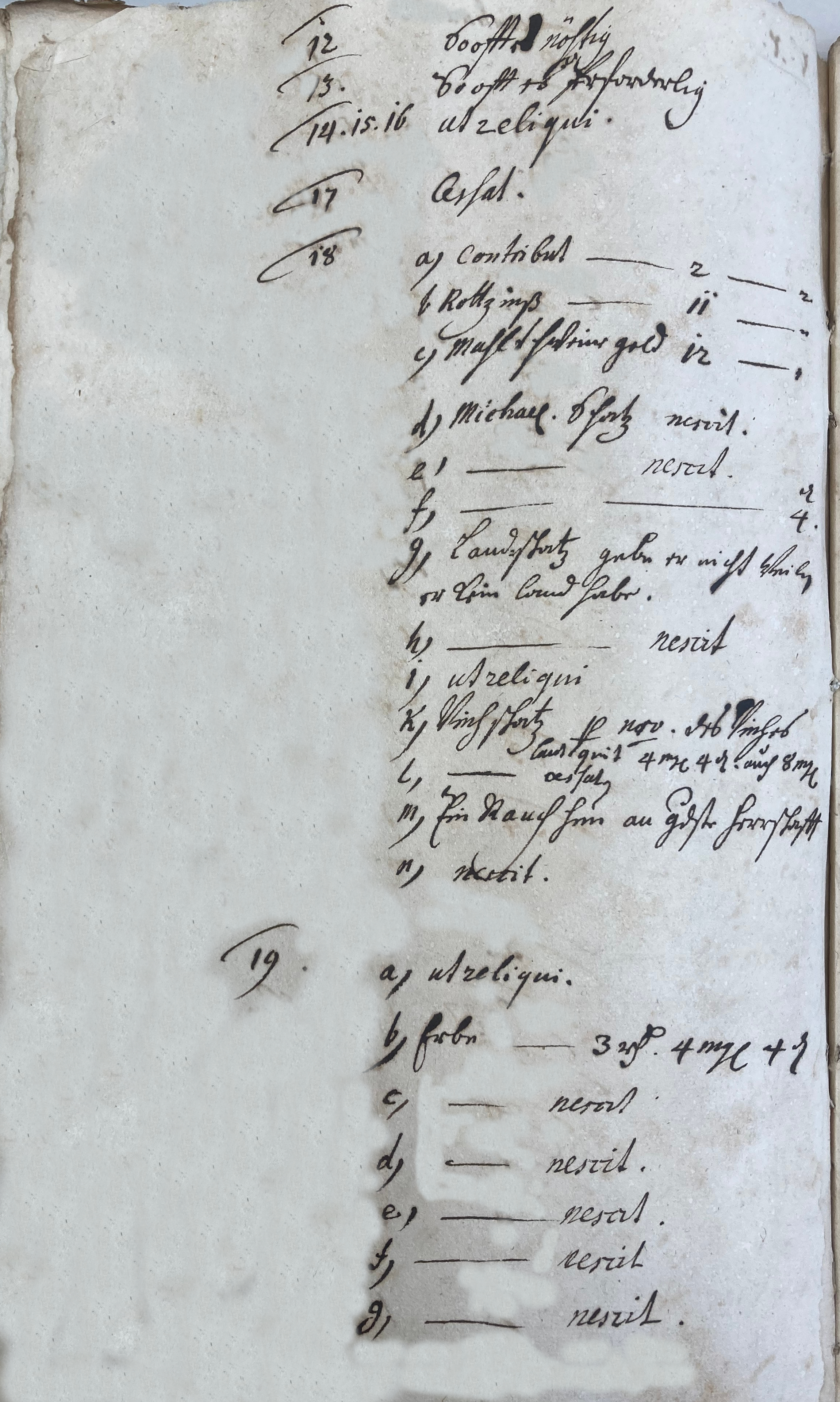
12. so offt es nöhtig

13. so offt es erforderlig [bei anderen: Landfolge mit der Hand]

14. 15. 16. ut reliqui [bei anderen: auch Jagd und Wachten]

17. cessat

18. [Dues listed below]

a) contribat 2 [Groschen] 2 [Pfennige]

b) Rottzinß 11 [Groschen]

c) Mahl[...] 12 [Groschen]

d) Michael Schatz cessit

e) –

f) – 4 [Pfennige]

g) Landschatz gibt er nicht weilen

er kein Land habe

h) nescit

i) ut reliqui

k) Viehschatz p nro. des Viehes

4 mgr [Groschen] 4 Pf [Pfennige] auch 8 mgr [Groschen]

l) cessat

m) Ein Rauchhuhn an gdste Herrschafft

n) nescit

19.

a) ut reliqui

b) Erbe 3 rthlr [Taler] 4 mgr [Groschen] 4 Pf [Pfennige]

c-g nescit

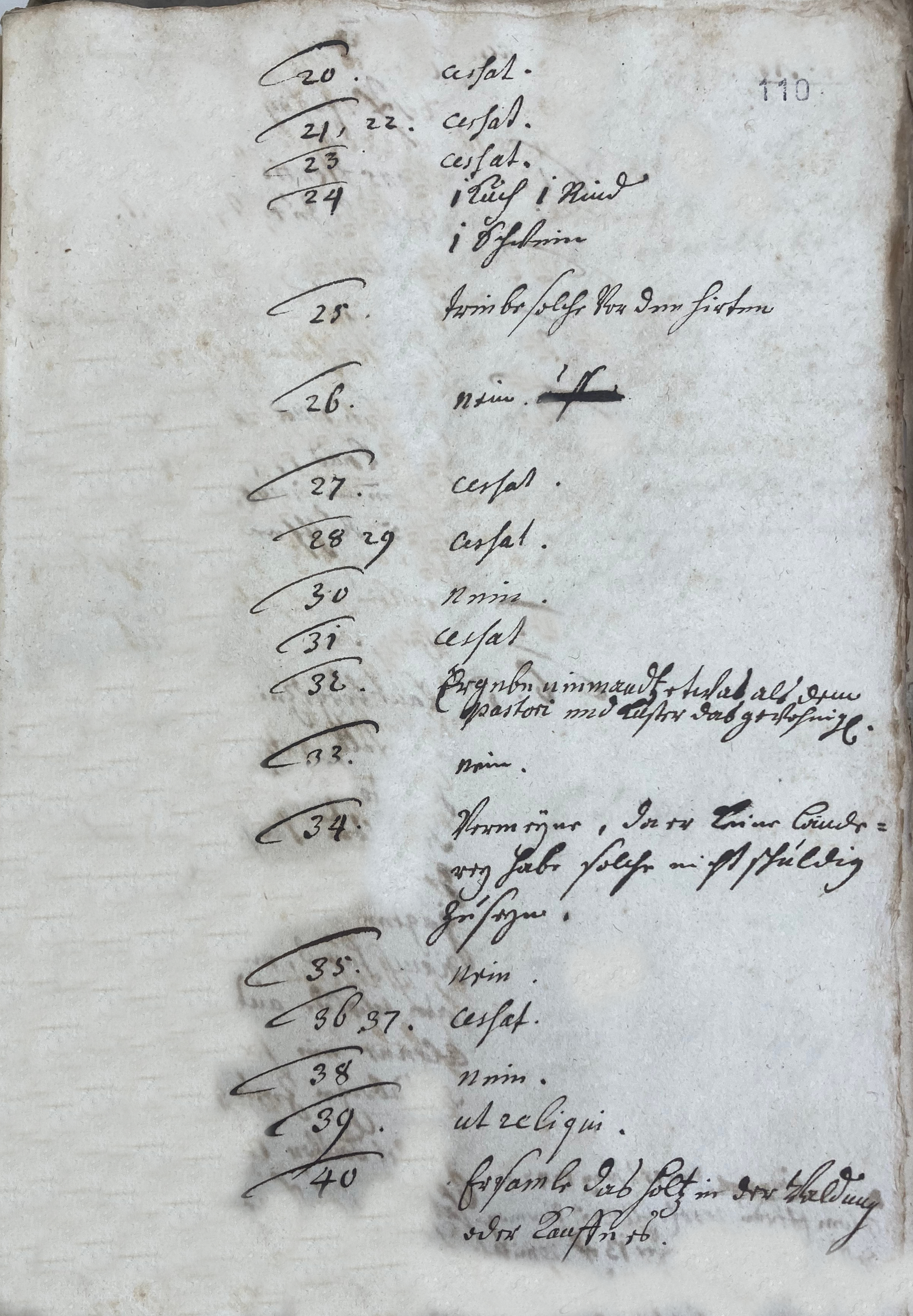
20-23. cessat

24. 1 Kuh 1 Rind

1 Schwein

25. treibe solche vor den Hirten

26. nein

27-31 cessat

32. Er gebe niemand

etwas als dem

pastori und Küster

das gewöhnliche

33. nein

34. Vermeyne, da er

keine Länderey

habe, solche nicht

schuldig zu seyn

35. nein

36., 37. cessat

38. nein

39. ut reliqui

40. Er samle

das Holtz in

der Waldung

oder kauffe es.
|
The reply to question #1 only gives the prior holders of no. 10 Berenbusch. It does not give the persons through whom the tenure right could pass. |
Heading: “N. X [Rentkammer-Fragen?] how he is called”

1. Johann Heinrich Krückeberg — formerly Friedrich Kuhlmann, also Johann Tönnies
   Eggerding
   Indicates earlier holders of the same dwelling/holding.

2. He married in connection with it.
   Formulaic reply indicating acquisition of the holding by marriage; the exact
   relationship to the predecessor is not specified.

3. A Brinksitzer
   Small cottager living on the village edge with minimal land.

4. He has nothing except a garden, in which also some seed-land according to
   the new survey
   Very small cultivated plot only, confirmed by cadastral measurement.

5. ceased / not applicable

6. He has no cleared land except the garden
   No independent Rottland holding.

7. Belonging to His Most Illustrious Lordship
   Direct territorial lord (domain property, not freehold).

8. Weekly services he performs not
   Exempt from regular weekly labor services.

9. Yearly 12 Burgfesten
   Twelve annual manorial labor or duty days owed to the manor.

10. ceased / not applicable

11. Five harvest days
   Obligatory harvest labor for the lord’s estate.

12. As often as necessary
   Occasional service upon demand.

13. As often as required
   Additional service obligations when called (others: land-escort duty).

14–16. Like the others
   Same communal obligations as fellow villagers (others: also hunting and watch
   duties).

17. ceased / not applicable

18. [Dues listed below]

a) Contribution tax — 2 Groschen 2 Pfennige
   General personal state tax, not tied to landholding.

b) Rottland rent — 11 Groschen
   Payment for use of cleared marginal land taken from forest or heath.

c) Milling due — 12 Groschen
   Fee for compulsory use of the lord’s mill (Mühlenzwang).

d) Michaelmas tax — ceased
   Former annual tax due at St. Michael’s Day (29 September) no longer owed.

e) none

f) Minor due — 4 Pfennige
   Small unspecified local fee, often court or parish related.

g) Land tax — not paid because he owns no land
   Indicates legally landless or near-landless status.

h) does not know
   Category not applicable or no obligation remembered.

i) like the others
   Pays the customary village amount.

k) Livestock tax according to number of animals — 4 Mariengroschen 4 Pfennige,
   also 8 Mariengroschen
   Assessed per head of livestock, probably different animal classes.

l) exempt / not applicable

m) One hearth-chicken to the gracious lordship
   Traditional household tribute (feudal survival).

n) does not know
   No obligation known in this category.

19.

a) like the others
   Pays the same customary obligation as the rest of the villagers.

b) Heriot — 3 Taler 4 Mariengroschen 4 Pfennige
   Death duty payable to the lord when the holding passes to a successor.

c–g does not know
   No known obligation in these categories.

20–23 not applicable

24. 1 cow, 1 young bovine, 1 pig
   Declared livestock in his possession.

25. He drives them with the village herdsman
   Animals kept in the communal herd, not privately pastured.

26. no

27–31 not applicable

32. He gives nothing to anyone except the pastor and sexton, the customary amount
   Only ordinary church dues (fees and offerings).

33. no

34. He believes that since he has no land he is not obliged to such
   Claims exemption from a land-based obligation.

35. no

36–37 not applicable

38. no

39. like the others
   Ordinary communal duty shared with villagers.

40. He gathers wood in the forest or buys it
   No independent timber rights; only collection or purchase allowed.