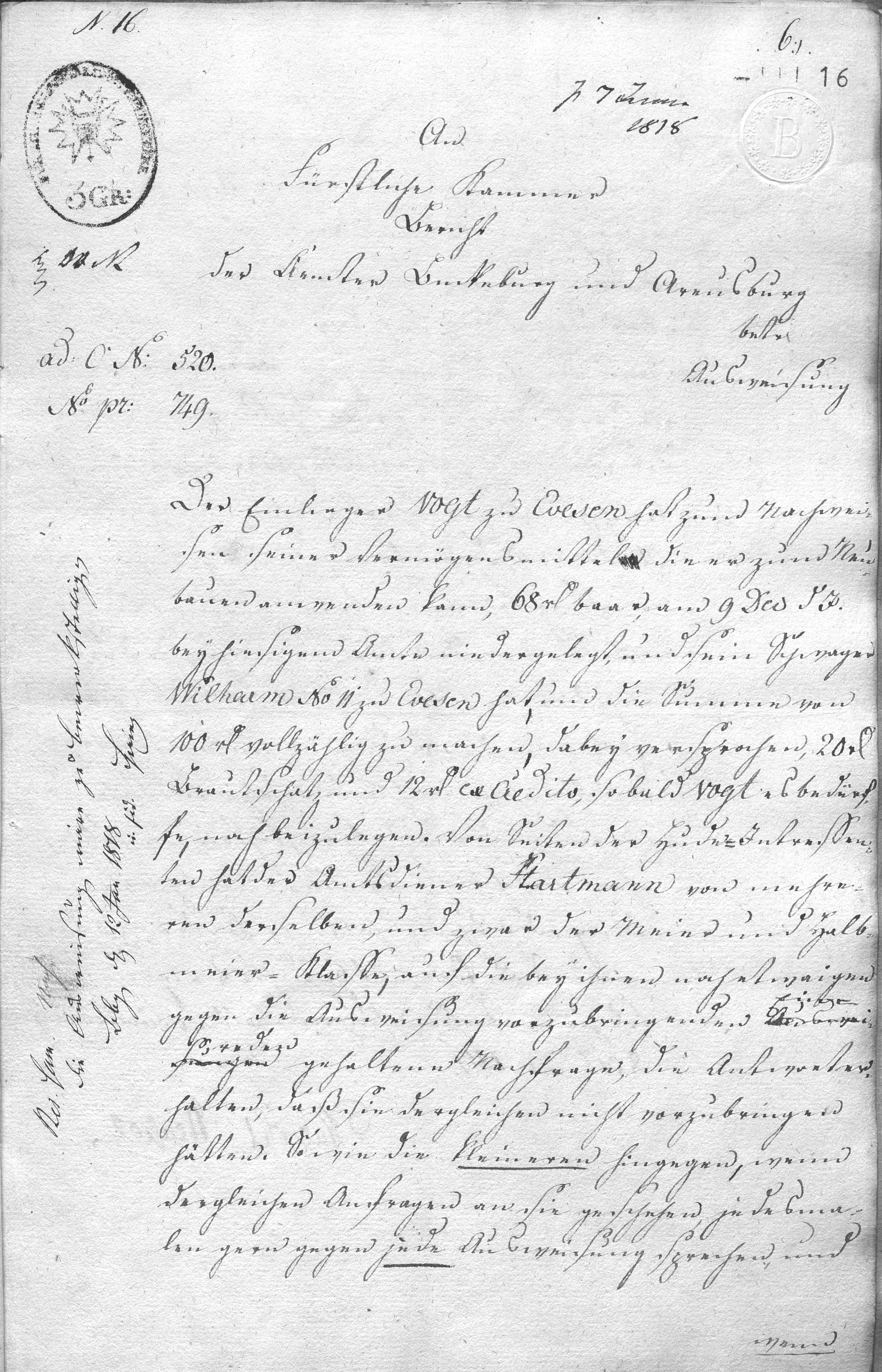
Document 6: Prepared official decision of the Princely Finance Office to the local office
Summary
The report recommends granting the land assignment to Vogt, who has demonstrated sufficient financial means. Some Hude-interest holders (specifically members of the Meier and Halbmeier class) were asked whether they had objections, and they stated that they had none.
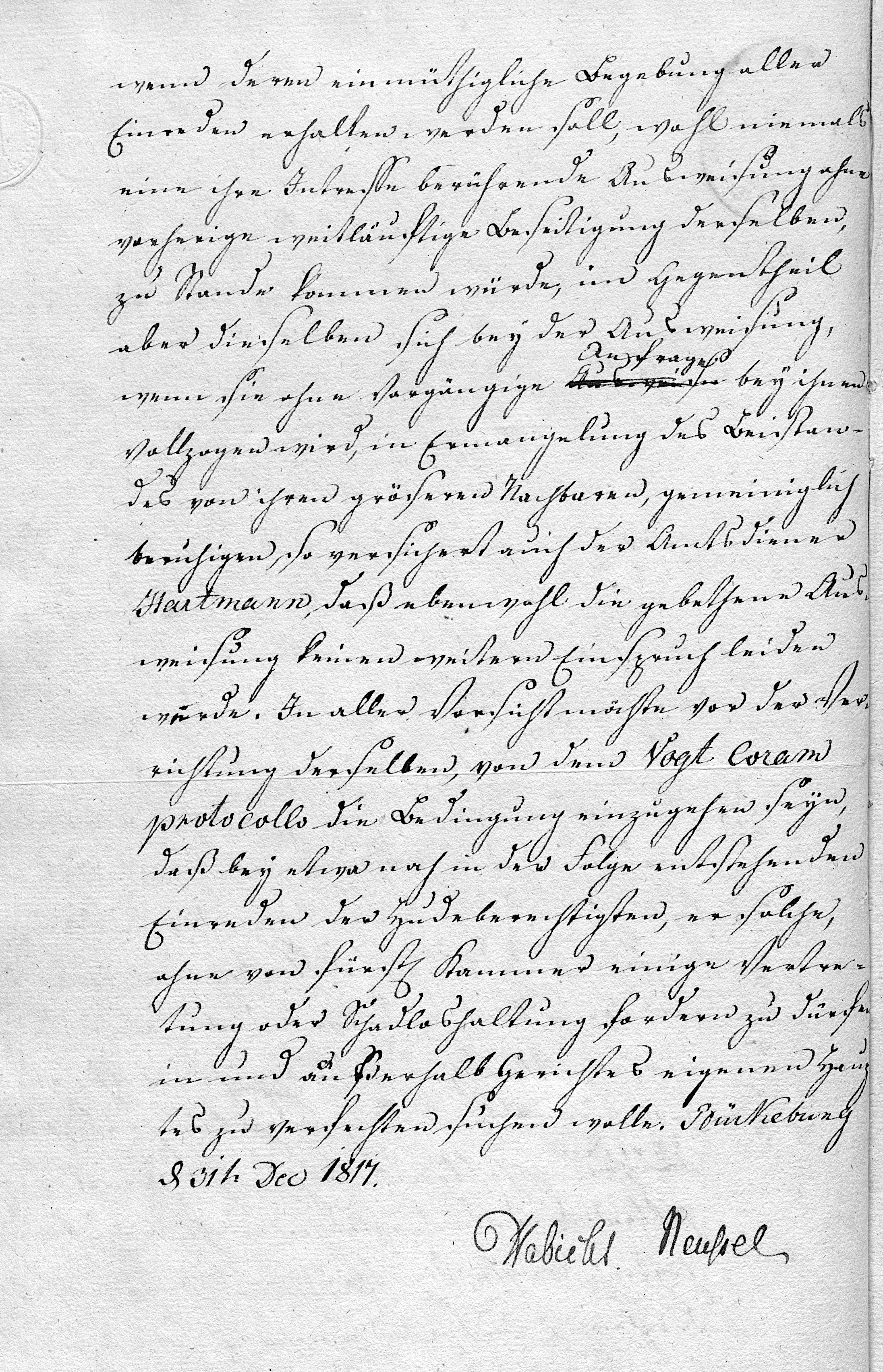
The report explains that smaller holders tend to object when formally asked, and that requiring unanimous waiver of all objections would make land assignments practically impossible without lengthy negotiations. In practice, however, when they are not formally consulted, they usually acquiesce because they lack the support of larger landholders.
Although no objections currently exist, Vogt must formally agree that if objections arise in the future, he will contest them himself, in and out of court, at his own expense, and without any right to legal representation or indemnification from the Princely Chamber.
Transliteration and Translation
N. 16                                                          6.,

[3 Gr Stempel]

[routing notation]

ad: C: N: 520
No pr: 749

p[räsenitert] 7 Juni 1818

Fürstliche Kammer Bericht der Ämter Bückeburg und Arensburg

Ausweisung

Der Einlieger Vogt zu Evesen hat zum Nachweisen seiner Vermögensmittel, die
er zum Neubauen anwenden kann, 68 rt bar, am 9 Dez. 17. bei hiesigem Amte
niedergelegt, und sein Schwager Wilharm Nr. 11 zu Evesen hat, um die Summe
von 100 rt vollzählig zu machen, dabei versprochen, 20 rt Brautschatz und
12 rt ex aedito, sobald Vogt es bedürffe, noch beizulegen. Von Seiten der
Hude-Interessenten hat der Amtsdiener Hartmann von mehreren derselben, und
zwar der Meier und Halbmeier-Klasse, auf die bei ihnen noch etwaigen gegen
die Ausweisung vorzubringenden Einreden gehaltene Nachfrage, die Antwort
erhalten, daß sie dergleichen nicht vorzubringen hätten. So wie die
kleineren hingegen, wenn dergleichen Anfragen an sie geschehen, jedes Mal
gern gegen jede Ausweisung sprechen, und wenn deren einmütigliche Begebung
aller Einreden erhalten werden soll, wohl niemals eine ihre Interessen
berührende Ausweisung ohne vorherige weitläufige Beseitigung derselben,
zustande kommen würde, im Gegenteil aber dieselben sich bei der Ausweisung,
wenn sie ohne vorgängige Anfrage bei ihnen vollzogen wird, in Ermangelung
des Beistandes von ihren größeren Nachbarn, gemeiniglich beruhigen, so
versichert auch der Amtsdiener Hartmann, daß ebenwohl die gebetene
Ausweisung keinen weiteren Einspruch leiden würde. In aller Vorsicht möchte
vor der Verrichtung derselben, von dem Vogt coram protocollo die Bedingung
einzugehen sein, daß bei etwa noch in der Folge entstehenden Einreden der
Hudeberechtigten, er solche, ohne von der fürstlichen Kammer Vertretung
oder Schadloshaltung fordern zu dürfen in und außerhalb Gerichtes eigenen
Hautes zu verfechten suchen wolle.

Bückeburg
d. 31. Dez. 1817.

Habicht Neufsel
No. 16                    6

[3 GR stamps]

[routing notation]

ad: C: N: 520
No pr: 749

Presented 7 June 1818

Princely Chamber
Report of the Offices of Bückeburg and Arensburg

Allotment

The Einlieger (lodger) Vogt of Evesen, in order to demonstrate the
financial means which he can apply to building a new house, deposited 68
Reichstaler in cash with the Office here on 9 December 1817. In addition,
his brother-in-law Wilharm No. 11 at Evesen, in order to make the sum of
100 Reichstaler complete, has promised to add 20 Reichstaler from a dowry
(Brautschatz) and 12 Reichstaler from previously declared funds (ex
aedito), as soon as Vogt should require it.

The office servant Hartmann, having inquired of several of the
Hude-interested parties (holders of grazing rights in the common forest),
namely those of the Meier and Halbmeier class, whether they had any
objections to raise against the proposed allotment, received the answer
that they had none. The smaller holders, however, whenever such inquiries
are made of them, are always inclined to speak against any allotment; and
if their unanimous waiver of all objections were to be required, an
allotment affecting their interests would hardly ever come about without a
prior extensive settlement of those objections. On the other hand, when an
allotment is carried out without a prior inquiry addressed to them, they
generally acquiesce in it for lack of support from their larger neighbors.
The office servant Hartmann therefore also assures that the allotment now
requested would likewise encounter no further objection.

As a precaution, however, before the allotment is carried out, Vogt should
formally agree—on the official record—to the following condition: that if
objections from the Hude-right holders should later arise, he will
undertake to defend the matter at his own risk, both in and out of court,
and may not demand representation or indemnification from the Princely
Chamber.

Bückeburg
31 December 1817

Habicht
Neufsel
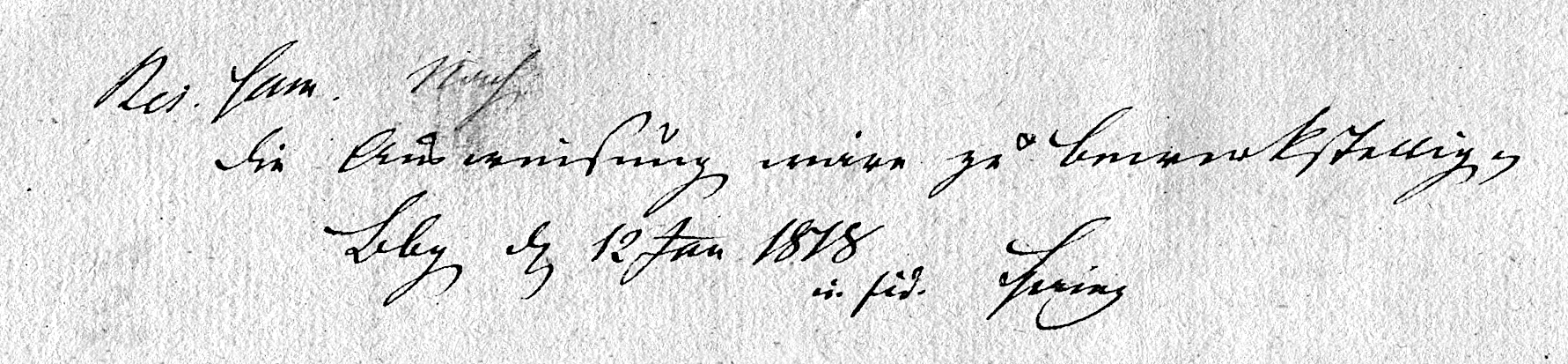
Notation about Document
It is a brief registry note indicating that the matter concerns the land allotment that is to be carried into effect under a Chamber resolution. It does not issue a new order; it simply records that the allotment stands in the implementation stage.
Res. Cam. Nach
die Ausweisung einer zu  bewirkfällige[n]
 Bbg d 12 Jan 1818
         in. fid. Spring
Chamber Resolution: Accordingly, the allotment is to be carried out.
Bückeburg, 12 January 1818.
Certified: Spring.